Category Archives: Uncategorized

Out in the World

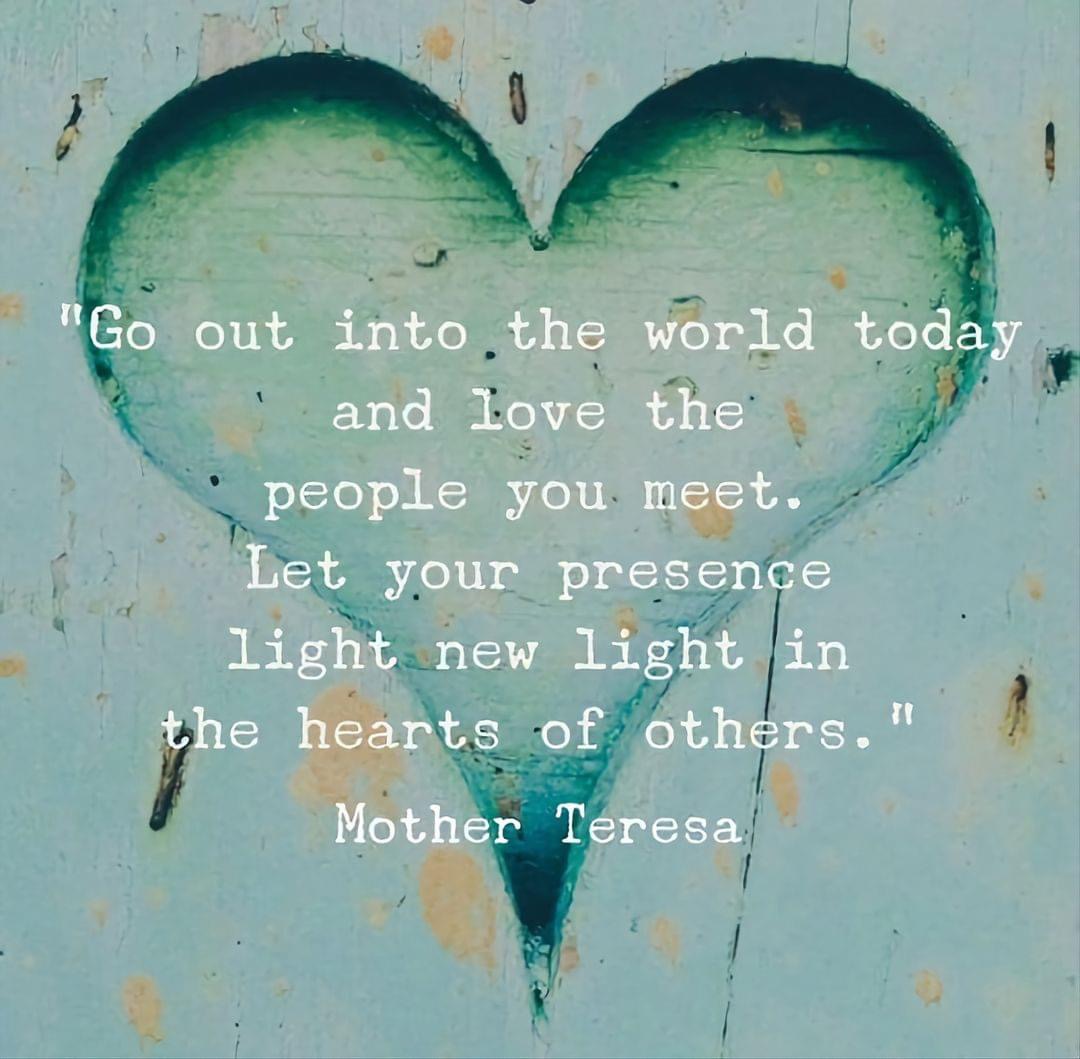
Image “borrowed” from FB Unify post.

That’s easier said than done. All of it, the going out into the world, the loving the people you meet, the lighting of a light in others, sounds so easy. But it’s not. It’s not easy at all. 

First, going out means getting dressed which is a lot easier than it used to be, I’ll admit. Nowadays, pulling on a pair of tights and a sweatshirt is perfectly acceptable for grocery shopping, drugstore runs, and vet visits. I can be out in the world in flip flops and a baseball cap, hair scrunched in a messy bun, clean torn jeans, and a funky shirt in a notched down boho kind of style. (Maybe style is too strong a word.) But no matter the clothing comfort level, going out means leaving the house and throwing myself into the maelstrom of life—where I might meet people. 

I don’t want to meet people much less love them. I don’t want to get close enough to risk disappointment in them or me. Meeting people means being open enough to share something of yourself, your name, for instance. I’m perfectly happy to be “that old lady next door,” “that woman with 12 cats,” “that woman in the sage green truck.” If I tell you my name, I’m giving you a piece of me that you can hang on to or use to contact me or stalk me with religious or political propaganda. No, I prefer to love people from afar, like from my window as they deliver my mail, or the window of my truck as they hand over a large coffee with cream only or a banana milkshake or a double cheeseburger. Those people I can love and appreciate. I might even love a stranger in a bookstore who offers a silent thumbs up on a book selection. In that case, I can offer a split-second open heart and a smile but that’s about it. Is that enough to light a light in someone else? Maybe, if that person also has an open heart and willingness to allow a simple smile to light their fire—in a spiritual way. 

I just don’t see myself as that person who is capable of starting a wildfire of love in strangers, whose mission it is in life to venture out into the world with open hearted abandon. I feel much more comfortable and willing to send out the energy of my love in other ways from the safety of my own comfy cave. To all of the other adventurous souls who love to roam outside sharing their love, I salute you and honor you. Fly far little birds. I’ll keep the home fires burning—with love from afar.

What If?

(Here we go again…)

What if your brain’s first function was as a tracking device? What if your brain’s only purpose was to serve as a point of attraction? What if the electromagnetic signals in your brain were designed as a receiver? 

What if life truly is an illusion? What if the combined power of your brain has created an illusionary world so powerful that you’ve lost the ability to make the distinction between reality and illusion? What if it is only the power of your thoughts combined that have created the sense of frustration and confusion that runs rampant in your world? 

What if your physical needs and environmental situation caused your brain to grow and expand beyond its original purpose? What if in your physical expansion your brain was hot-wired, reworked to obscure the brain’s original purpose as a beacon? What if a virus was contracted that created a cloud of confusion, a separation and a loss of your brain’s original purpose? What if your thoughts seem more real than the reality that your brain is actually linked with every other brain, as well as with source, to receive love and abundance? 

What if all of the add-ons could be wiped away and your brain returned to its primary function? What if every thought, idea, and belief could be removed from your brain? What if every worry, frustration, and barrier could be removed from your life? What if the light within you encountered no obstacle, no barrier in shining eternally? What if that light brought you everything you wanted with no restrictions or obligations? What if your only purpose in life is to experience love and the acceptance of your being? 

What if this is the way life was meant to be experienced, if all that we are was finally exposed? It might bring new meaning to the idea of love and light. 

Downloading or Uploading?

Looking Back

Have you ever looked back at something you’ve written—a letter, a journal entry, the beginnings of a story, long or short—and wondered, “Who is that person who wrote this? Where did this come from?” 

Coming back from a recent bout of COVID, trying to get back to myself, I’ve been spending time looking over old journal entries, essays, pages of musings and scraps of writing. It’s funny to me that I don’t remember writing a lot of what I’ve kept in files and journals, a collection of ramblings that seem unfamiliar but nevertheless strike a chord with the me of today.

She walked quietly through her life like a shadow, keeping a low profile, offering a smile and kindness to strangers, love to her children, and support and strength where needed, often without a word, usually with patience, always with restraint, afraid to open her heart and her thoughts, unwilling to disturb the chaos within. If the door opened just a crack, out would slip the wild creature she believed herself to be, that wild haired, laughing soul of ricocheting emotions, uninhabited, uninhibited, running freely into the wind—and more than likely off a cliff. No, she kept her battened down, silent, trapped, barred from life in the sun, anemic, craving, wanting life, a dry corpse tethered to fear. And that was on a good day.

I wrote this passage almost ten years ago in 2015, back before a move to California, way back before my move back to Ohio, but a very long time after my move from Santa Fe. There is nothing autobiographical here, yet I recognize that woman, the one closed off and empty and craving. I think we must all have those moments when we recognize some element of ourselves, good or bad, happy or sad, that resonates and makes us think about the past and the future—or the present. I look back and see a spiral of events and incidents that have moved me forward in time if not in evolution. I think of that line in True Detective: “Time is a flat circle. Everything we’ve ever done or will do, we’re gonna do over and over and over again,” which is a reference itself to Friedrich Nietzsche’s concept of eternal recurrence, and I wonder if everything I write is a remnant of a former or future self. 

The road was dusty under her feet. She shuffled along, angry, frustrated, willing the hours to fly by and the road to contract somehow, magically perhaps, so that she would find herself closer to home at the end of the day, a day overcast with intermittent rays of sunshine peeking out from behind gray clouds casting shadows behind her eyes, pressure on her sinuses, and a glare that made her eyes water. One fucking foot in front of the other, she recited in mantra-like fashion. The ohms and namastes of her former life had been left at the dusty edge of the desert along with her old beater Prius and the two worn black leather bags that contained the remnants of her life: clean jeans, underwear, two t-shirts, her grandmother’s bible, her mother’s wedding ring, assorted letters, books, and keepsakes, and the last photo of him she’d taken before he left her stranded in New Mexico. He looked dark and brooding in the photo, his eyes flat and hooded, his hair and beard windblown and tangled. They’d been living rough for several weeks, giving nature and their relationship a second chance. She’d been happy enough to live hand to mouth with him in those final days, exploring, hiking, living on the edge of life physically and metaphorically. They had hit their peak and begun the descent into oblivion when he’d simply rolled away leaving the fumes of the Greyhound’s exhaust settling in her lungs. She’d boarded the next bus herself, headed in the opposite direction toward home and had arrived with a broken heart, a damaged spirit, and a shitload of determination to begin her life again. Alone. 

Sometimes it feels as though every day of my life is a crossroads. Forget the fork that turns ever so slightly in a new direction. My choices are hard right, hard left, back or straight ahead. Most days, I choose straight ahead but on days like today, I choose a detour that leads me back. 

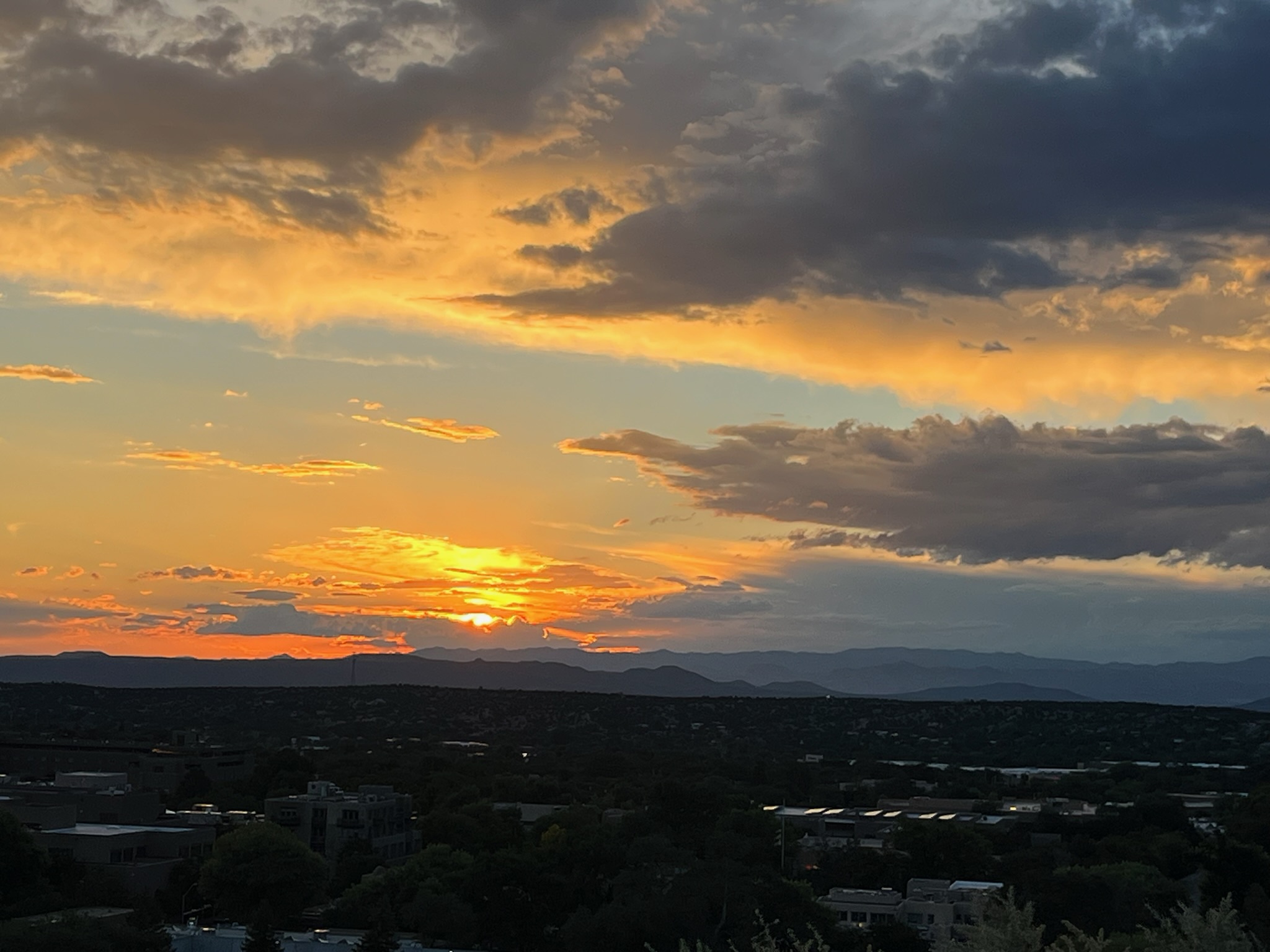
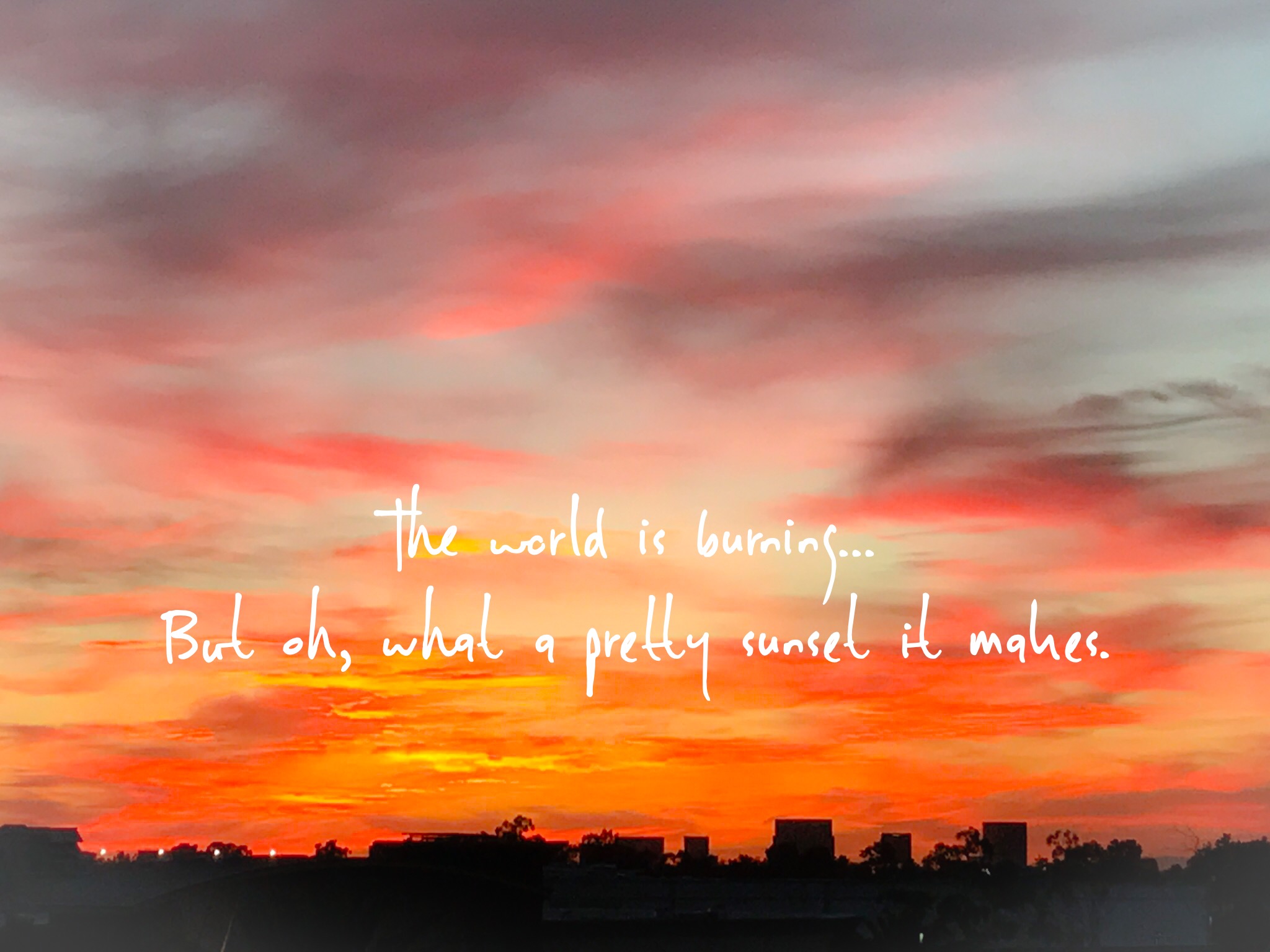
Sunset from the Cross of the Martyrs, Santa Fe, New Mexico

What if?

What if Alzheimer’s is a natural human phenomenon? What if, rather than a disease, Alzheimer’s is the natural way our brains are formed to protect us from the gradual loss of familial connection or recognition. In college, I read an article about the reason for the pheromonally induced sense of wonder and awe human’s experience at the sight of a sleeping baby. This is the feeling that keeps us from smothering babies in their sleep as harbingers of sleepless nights, pain, and discomfort. What if, as we grow older, our brains’ mechanism is to loosen the bonds that hold us all clinging together. What if, like the natural rebellion humans go through during the teenage years, we find a way to slip from the bondage of relationships that might otherwise keep us in torment at the thought of leaving. How hard would it have been for a close-knit family to float their elderly relatives away in a wave of ice floes if they were still functioning, connected, albeit older people.

What if loss of memory helps reshape our experience in the world, softening the blows, putting into perspective those things that are important while shunting aside the superfluous, minor, painful memories. 

What if the repetition we experience in story telling as we get older is the natural pattern in a society of oral history story tellers? It would be natural for the oldest and perhaps the wisest to tell and retell their version of history to reinforce lessons learned. 

I am thinking of my ninety-four-year-old father as I ponder these thoughts. Throughout my childhood, he lamented his own upbringing, telling us stories of growing up in a hand-built garage turned house on a two-acre farm in rural Ohio. His father—my grandfather—thought nothing of trading anything he could get his hands on including dogs, horses, and once my father’s new Schwinn bike with raccoon tails on the handlebars. His father was taciturn, quiet, angry, short-tempered, unrelenting, averse to art and idleness as well as wasting money on movies or frivolous endeavors. It was left to my father to entertain his mother, to see that she had company on shopping trips and movie outings. He felt his father neglected his mother terribly, never thinking of her happiness or comfort. Now, however, my father gushes over the beauty and simplicity of his childhood, lauds his father for his craftiness; praises his mother and his parents for giving him the perfect environment in which to grow and prosper. It seems he has forgotten his earlier grim stories, a fact I would never bring up and one for which I am extremely thankful.

What if this final letting go of the past facilitates the ease of transition from one plane of existence to another. What if what we see as illness and disease is simply nature paving our way to the next chapter.

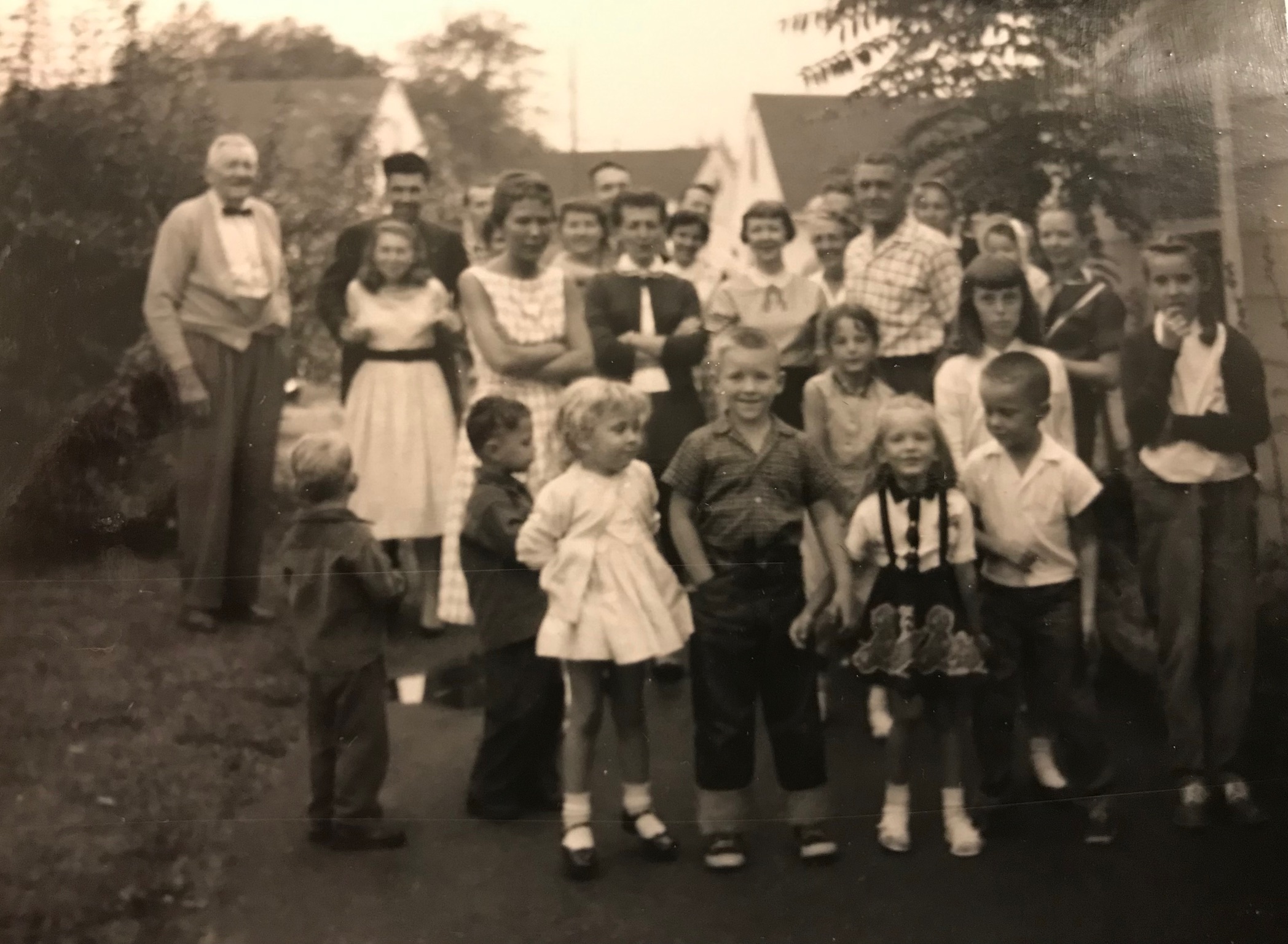
Memories of long, long ago.

Lalalalalalalalala

Like many people, I’ve grown weary of politics and polls and election coverage, debates and arguments over age and senility and court cases out the wazoo. It feels like we’ve been smothered by non-stop political drama for years with no respite and I’m convinced there is no end in sight. Given the current political climate of divisiveness, no matter what happens in November, protestations and appeals will bleed into 2025 and 2026 and on and on until something drastic happens that will either pull us all back together or blow us all off the face of the planet. 

Depending on which channel you tune into, we are facing prospects of civil war, World War 3, or mass ascension to a 5D new Earth. I have yet to see or hear a prediction that suggests that the drama will blow over, the economy will settle, the church and the state will find themselves in their own lanes, and truth, justice, and the American way will once again prevail. We used to know precisely what that last phrase meant: telling lies got you in trouble; if you broke the law, there were consequences; and all men were created equal with the right to life, liberty, and the pursuit of happiness. 

In know, I know. That’s all a bunch of naïve claptrap. If we pick it apart and everyone has the right to their own subjective opinion on what each and every word means, and has their own god given right to stretch the truth or, for better or worse, create their own alternative truth based on alternative facts, then we can all exist in our own little bubble worlds of self righteous indignation f/k/a bliss. 

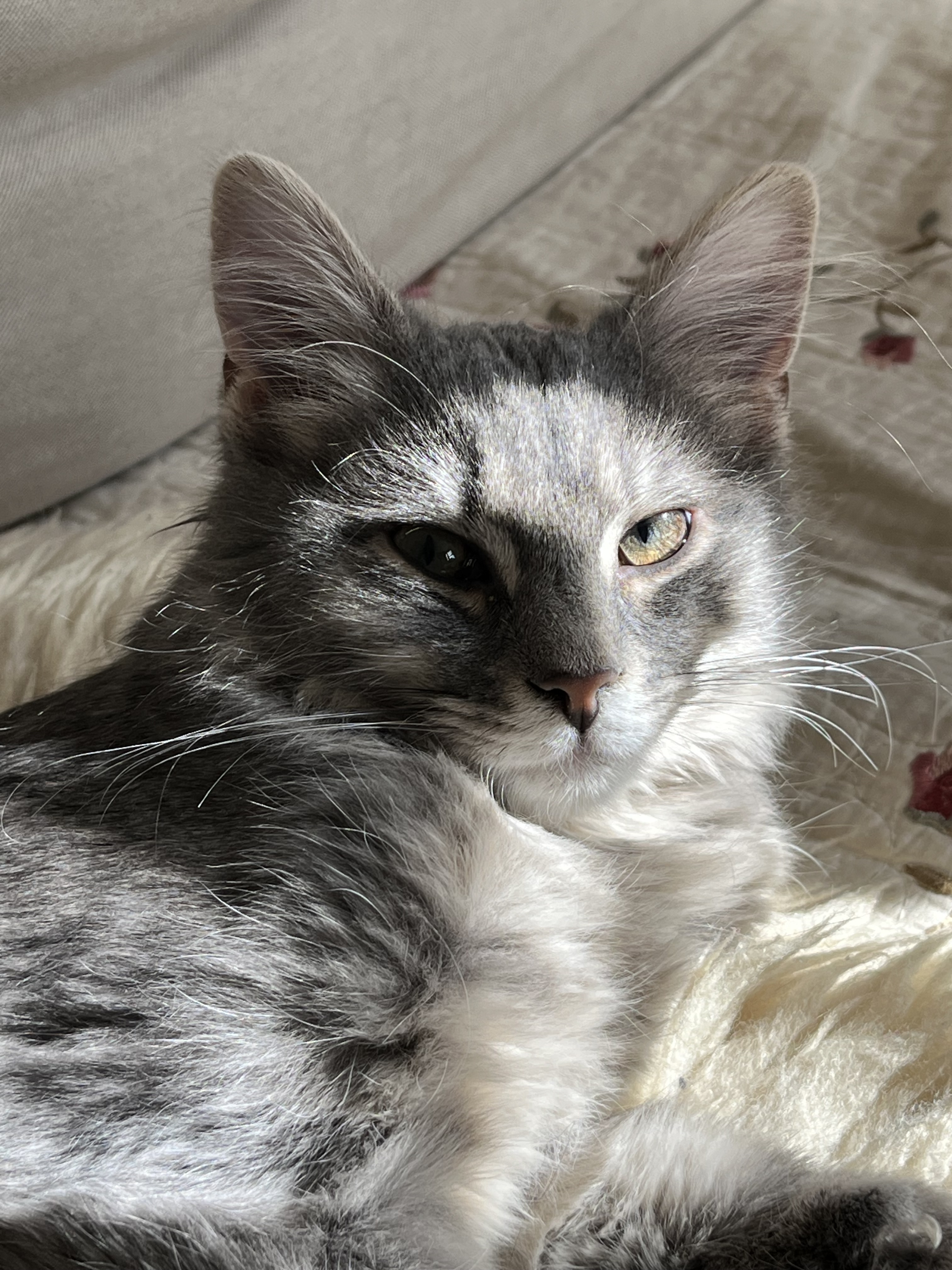
Today, I am employing my own defense against the crazy. It’s simple:  I will paint and read and exercise and nap, sit by the window with a cup of tea and watch the rain, and I will pet my cats, all 12 of them. And if anything invades my comfy cave, I’ll simply put my fingers in my ears and lalalalalalalala it all away. Try it! I’m sure you could use a break. 

Bongo, one of my favorite therapists.

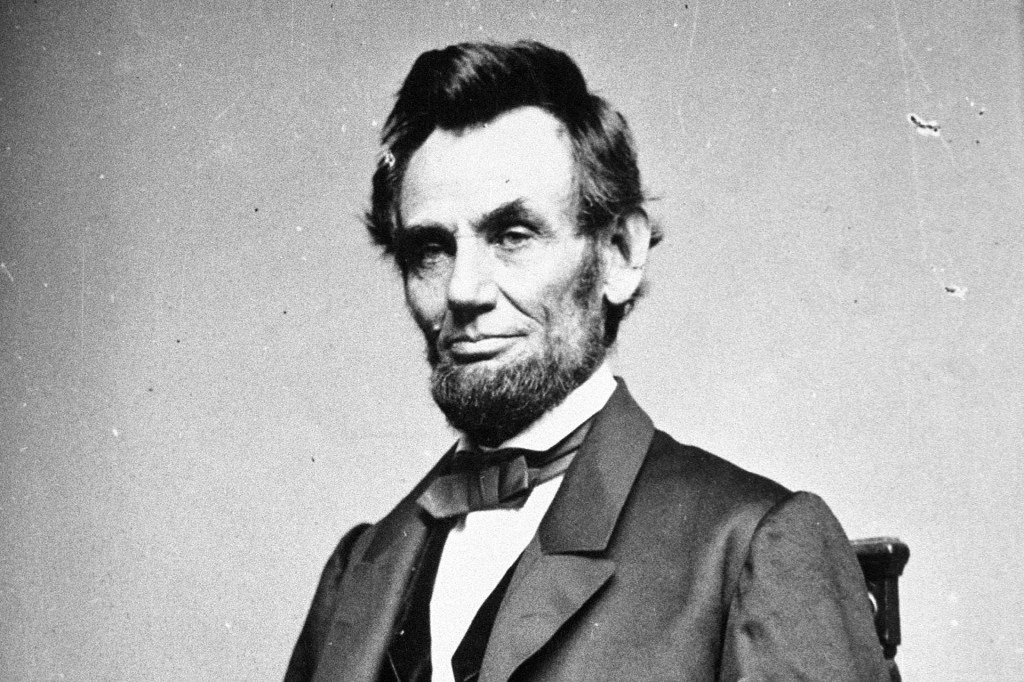
Happy Presidents Day!

Is it just me or does Presidents Day feel more auspicious than usual? Maybe it’s because this is an election year. Maybe it’s because we are yearning for the seeming stability of the presidents we idolized in grade school. Or maybe it’s because we are all inundated with breaking political news every five seconds and the media’s obsession with comparing and contrasting every flub and foible uttered by the presumptive candidates. For me, it’s safer for my sanity to just read the highlights of the day, preferably from Letters from an American, and go about my day in my comfy cave minding my own business.

I’m happy though, that we still remember and memorialize George Washington and Abraham Lincoln. Frankly, I’m happy that we remember any history at all given the environment of persecution and denial we live in. I have fond memories of learning about our forefathers, memorizing the old tropes of reading by candlelight and walking miles to return a borrowed book. Reading under the covers by flashlight after lights out seemed acceptable to my young mind. Lincoln’s dedication to learning made it okay for me to read A Wrinkle in Time for the tenth time after midnight. George Washington, on the other hand, while a great president, was a wish-washy role model. In fact, I held a grudge against George  between the ages of six and eight. Telling the truth was an admirable quality but chopping down that cherry tree in the first place was unforgivable. 

Two houses down from us lived the Thompsons, an older couple with no kids. Their backyard and ours, as well as several yards in both directions from our back door, were connected by a field of grass, wild flowers, and clover. Smack in the middle of the Thompsons’ yard was a huge cherry tree redolent of blossoms in the spring and heavy with fruit through the summer. That tree was also smack in the middle of my run to my best friend’s house two doors down from the Thompsons. One day on my way to Paige’s house, Mr Thompson caught me gazing up at the ripening cherries and made me a friendly offer. I could eat all of the cherries that fell from the tree if I promised not to climb it. I quickly agreed and kept my promise. At every opportunity, I gorged on the abundance of cherries that fell from the tree.

I loved that cherry tree in all its glory, festooned in blossoms, green leaves, or snow covered limbs but summertime, despite the risk of stepping on honey bees with my bare feet, was the best. Two summers later, my parents had built a house and we were moving. I walked around to the backyard, heading out to say goodbye to Mr Thompson. From the edge of our yard, I watched as he carefully shook each lower branch of the cherry tree, dropping the ripe cherries to the ground. For me, I realized. That’s why there were always so many!

That George Washington, the father of our country would have the audacity to chop down something so beautiful as a cherry tree felt traitorous to me, to my love for the cherries, to the tree, and I think to Mr Thompson and his generous spirit. To my great relief, I later learned that the story was fabricated, like so many stories we hear today in an attempt to laud or defame. 

We need truth to keep us on course and we need leaders who in their humble humanity challenge and inspire us to be better and to do better. We need men like Lincoln and Washington to remind us where we come from and how far we have come. 

Life Changes—and Everything Stays the Same

How long can a caterpillar live in its chrysalis? How long can a bear hibernate? How long can a cave dweller hide from the world before the natural laws of nature kick in and force us out into the bright light of day? Change happens and if we’re lucky, growth happens, evolution happens, life happens and we learn to adapt to our new surroundings.

I haven’t written since 2020 or talked about the pandemic. I felt the world’s pain and frustration but my family was lucky. We made it through the pandemic years unscathed, healthy, safe and sound. My life wasn’t significantly different when the world shut down. My husband continued to work and shop (I hate to shop!) I stayed home (nothing different there) and continued to struggle with my weight, dealing with it through diet and exercise, getting fit and then falling into deprivation mentality and eating whatever the hell I wanted. But in 2023, a daunting birthday was looming and I was determined to go into my 70s strong and resilient, flexible and fit.

To celebrate my birthday in September, my daughter and I spent a week in New Mexico, revisiting old haunts and luxuriating in the mineral waters of Ojo Caliente. It was fabulous! I felt renewed, refreshed, reinvigorated. I came home and burrowed into my comfy cave where I stayed until January, not writing, not painting, just being.

January 2024 began full of hope and wonder.

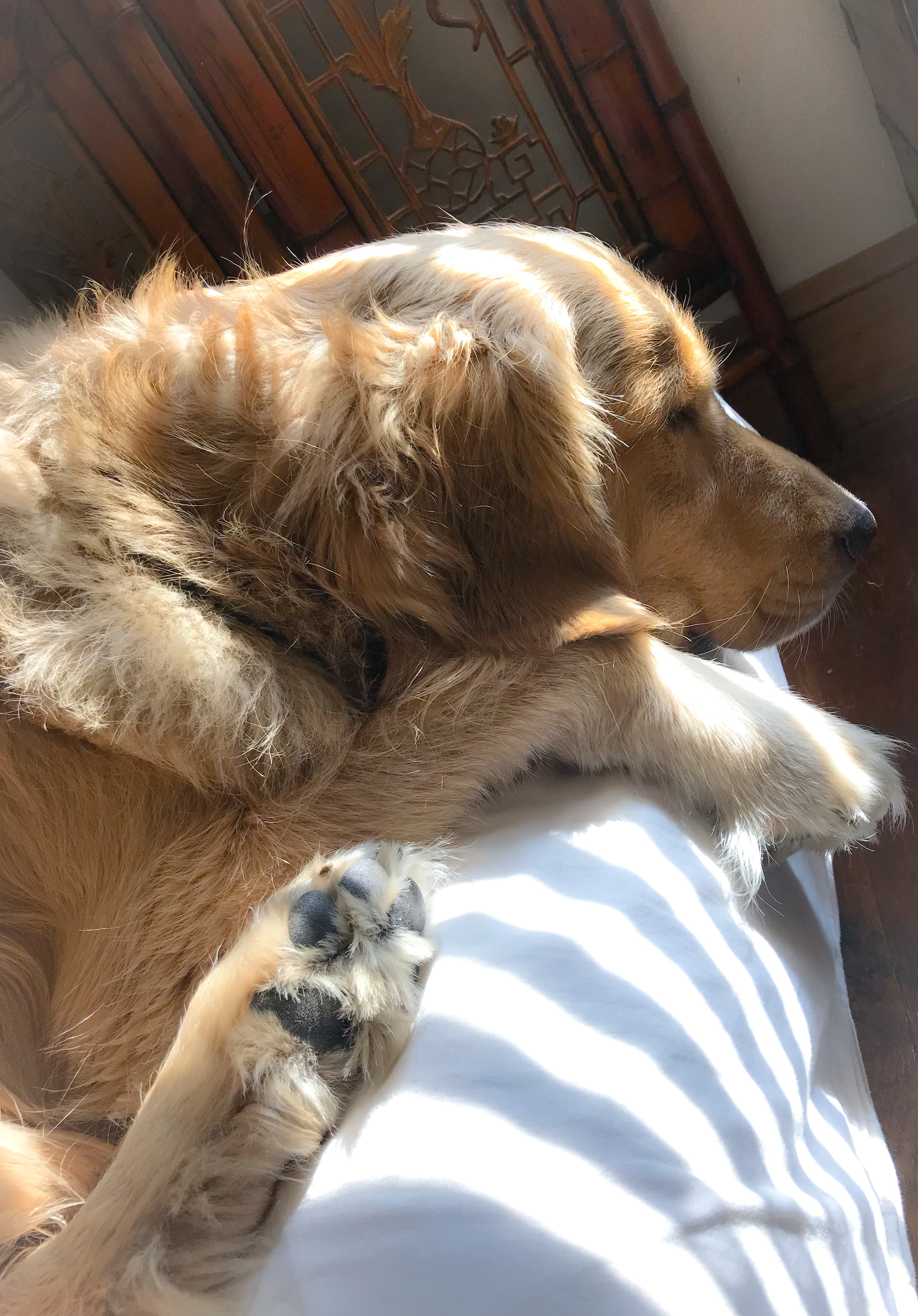
On January 3, we lost Max, our beautiful six-year-old golden retriever to cancer. It happened so fast! At four o’clock, he was a happy, bouncing, cat-chasing, healthy dog. At six, he refused his dinner, turning his head and ignoring both me and his bowl. I stayed close to him, slept on the couch next to him as he stretched out on the floor, my hand on his back, feeling for changes in his breath or heartbeat. By the next morning, he could barely walk. The vet at the animal hospital diagnosed a ruptured tumor. Max was bleeding internally. His X-rays showed multiple tumors, indicators of cancer. We had to let him go.

One week after Max, still reeling from the loss, I felt a cold coming on. Two weeks after Max, I found myself at the ER diagnosed with COVID. I’d missed the five day window for treatment—every day I’d told myself, “I’ll feel better tomorrow,” and every day I’d felt worse. A month later, I still feel weak and listless but the cough is gone and I can breathe comfortably again. 

So, my big plan to go into a new era of my life and a new year full of opportunity fell by the wayside as I struggled physically and emotionally just to stay alive. I am surviving day by day, which is an improvement from the dark days of surviving minute by minute. I remember giving up, surrendering to the illness, surrendering to whatever comes next. But I’m still here. 

My life is changing. I’ve stopped watching the news. I’ve rearranged my office and expanded my attic studio. I’m creating a space for me, the expansive, evolutionary me that I am becoming. I’ve decided if I’m going to live in the present minute by minute, day by day, then I will use those minutes and days to create the life that I am dreaming, the me that is a writer and a painter and a woman who is all she wants to be. I know I’ve said this all before but this time it must be different. Life changes—and everything stays the same, but different this time.

Happy February 2024!

Maximus Sayre

Dreams or Life Lessons?

While my daily life has taken a quiet turn, my dream life has intensified of late. I dream of my brothers with an overlay of long gone relatives, aunts and uncles, and a shimmer of my grandmother standing on the sidelines watching. My dreams are colorful, intense, and vivid enough to follow me through the day. 

Last night I dreamed of a boy. His name was Suluman. 

Suluman was a dark-haired, dark-skinned, dark-eyed little boy of about ten, small in body but with a vibrant radiance. Suluman was shy yet mischievous and seemed to be constantly in trouble at school. His teacher often kept Suluman after class where she felt it was her right and her duty to slap and hit him, to malign his behavior, his family, and his intelligence, all in an effort to make him better. Suluman suffered this treatment in silence. 

The teacher, who prided herself on her civic responsibility, was involved with a group of women who worked to rescue orphaned or compromised children. They had heard of a child who was in dire straits, a boy who was beaten and mistreated, starved and maligned, a child hunted and terrorized. The teacher would attack poor Suluman and then run breathless from the school to aid in the search for the boy. 

Suluman showed up at my house to play with my children. His face was swollen and bruised and although his demeanor was that of a happy little boy, I could see the pain in his eyes. “She hits me for no reason,” he said. “I don’t do anything wrong, I promise!”

I confronted his teacher (in that no time lapse way of dreams) and she admitted that she often had to correct the boy, punish him for this misdeed or that. “He’s lucky,” she said. “He thinks he has problems but you should hear about this other boy I’m trying to save. He’s beaten, starved, hunted and terrorized. We must save him!”

“Who is this child you’re searching for?” I asked.

“We don’t know where he is or how to find him, but his name is Suluman.”

Suluman. 

I put my hand on Suluman’s thin shoulder. “This is Suluman,” I said. 

I woke up with Suluman’s little face in my mind, thinking about the teacher, the boy, and the search for someone to save. I’m not sure how to interpret my dream but it seems important to understand how we can look for salvation far beyond ourselves while ignoring what’s right under our noses. 

“Don’t ignore your dreams, in them your soul is awake and you are your true self.”       

           Bangambiki Habyarimana (Pearls of Eternity)

W%UvWbzWQrSo0QAWdzdHxg

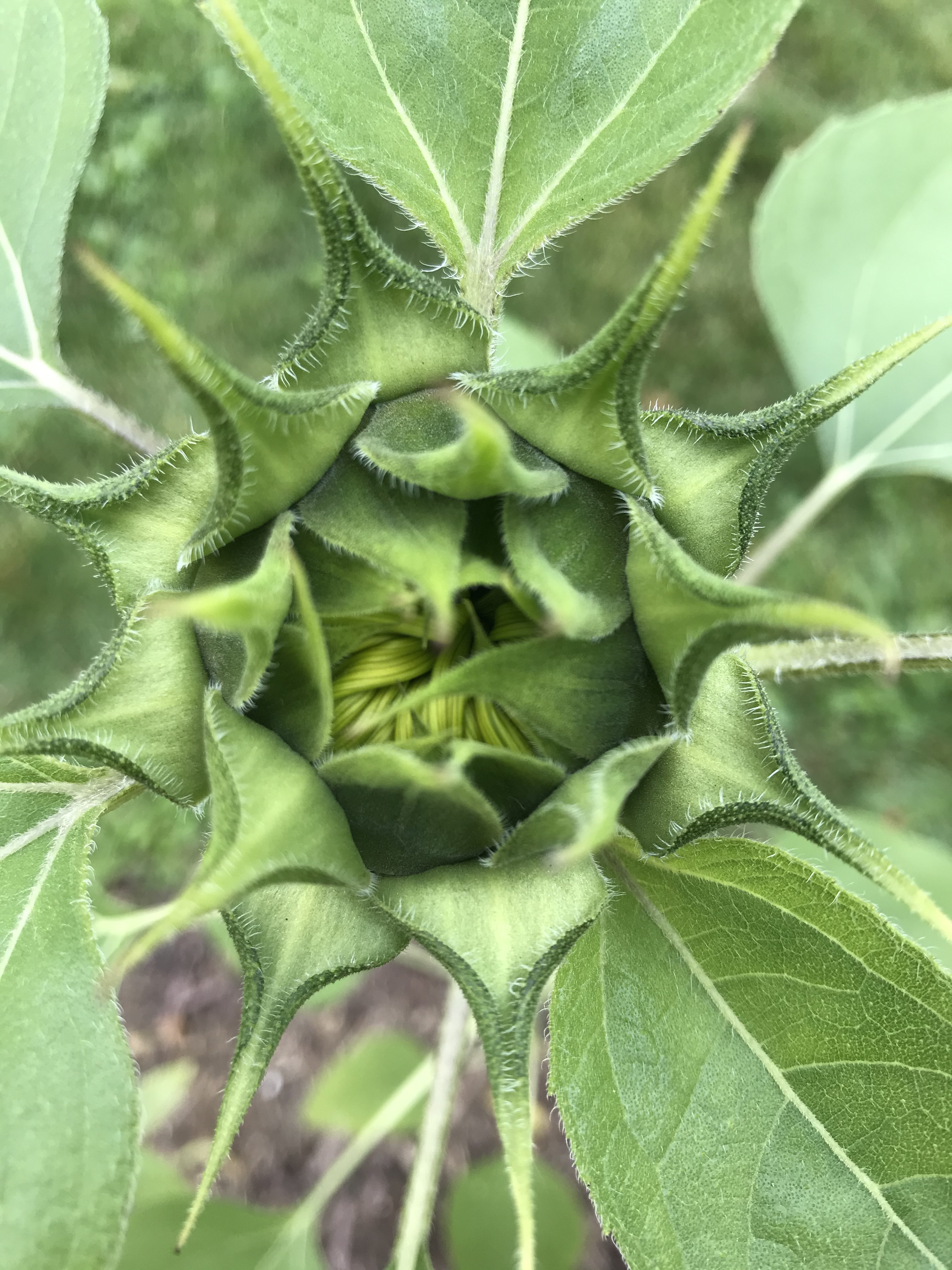
Holding tight to a secret: a late blooming sunflower from my back garden.

Winter is Here (Still)


IMG_0554

Yesterday was a mish-mash of relaxed urgency for a Sunday, reading the paper and then running to Costco to remedy a billing debacle, and the excited hurry-up-and-wait drama of the return of Games of Thrones. By 9:00, I was ready to retreat to my cave and just watch all the reunion-y goodness and the requisite badness of GOT. Personally, I think it was worth the wait.

In keeping with the GOT winter theme in my little cave, it’s snowing here in Ohio this morning. After several days of temps in the 60s and 70s, the budding tulips and fragile spring flowers are getting one more soft white blanket. One can only hope that it won’t last long and is not a harbinger of still more winter to come–or the coming of the Knight’s King (according to GRRM) which would not surprise me in the least.

On to other things: Chapter 3 in the saga of George Fairweather. I hope you’ll let me know what you think.

Chapter 3

George was happy to discover that William would be spending the entire summer with her great-aunt Harriett over on Wilbersham Terrace, just a hop, skip, and a jump from George’s own front porch. It took no time at all for the girls to work out a routine of reading, laughing, and playing during their long warm days of summer. George’s mother soon grew accustomed to leaving a muffin and a cup of milk on the counter by the back door rather than scolding George for not eating a proper breakfast.

“No time!’ George would shout as she scooted out the back door. She would, however, take a moment to drink the milk and grab the muffin, more often than not stuffing it into her pocket to share with William which was better than nothing, her mother figured. She often didn’t see her daughter again until just before dark when George would come running through the back door, skidding across the linoleum to beat her curfew.

“The light on Maple just blinked on!” she’d announce breathless, having run all the way from William’s.

“Wash your hands…” Rita began,

“…and your face and tidy up,” George finished for her. “I know, I know. I’m a mess.”

Wash up finished, George would sit with her mother for an early supper, usually a light meal of tuna sandwiches or a casserole and peas.

“Anything interesting happening in the village?” her mother would always inquire.

“Not really,” was the standard answer, although George could be counted on to dish the details if anything at all was going on.

“Did you hear about Mrs. Crawford’s tumble down the stairs?” George asked. “She had a doctor’s appointment and was supposed to meet her sister Ruth at the curb for a ride. When she didn’t come out, Ruth went in and found poor Mrs. Crawford all in a jumble at the foot of the stairs, knocked out cold—or so she said.”

“Who said?” her mother asked, daintily picking at her food.

“Mrs. Crawford’s sister Ruth.” George stopped eating her sandwich and looked directly at her mother. “I’ve heard her yell at Mrs. Crawford in the grocery, telling her to hurry up, nudging her sharply. I wouldn’t be surprised if she batted her sister over the head and knocked her out just to make the story more interesting. I’ll bet Mrs. Crawford had simply fallen and was probably calling for help.”

Rita sighed loudly. “Now, sweetheart, there’s no need to elaborate on the facts. A tumble down the stairs at Mrs. Crawford’s age could very well have knocked her unconscious. I doubt very much if her sister would do something as mean as hitting her sister after such an event. Where do you get such outlandish ideas?”

George gazed off into the distance, thinking. “I don’t know,” she replied. “Maybe too much television.”

“Then I suppose we should put a limit on how much you watch. Or maybe just stick to uplifting programs.”

Rita doubted television made much of an impact on her daughter. As a family they rarely watched TV, all three, mother, father, and daughter, preferring books to television, especially her daughter who since she’d learned to read at the age of three, was determined to read into the wee hours of the morning. Turning out the bedroom light and going to sleep had long since been a battle Rita had rarely won. Her daughter preferred to go to school happily sleepy rather than go to sleep not knowing how a story ended. Rita understood and only very rarely enforced the midnight lights out rule. She herself could stay up reading until dawn and with only an occasional yawn or two, make it all the way through the day and into evening. Reading through to the end of a book was a happy thrill only superseded by the thrill of beginning a new one. So, Rita and her daughter were constantly in a state of happy satisfaction or even happier anticipation.

Unless, of course, the book they were reading was a real stinker which happened now and again. When that was the case, there was no happiness to be found in the Wilson household for everyone knew it from the grumbles and sighs and angry exhortations that bounced through the house at all hours.

“You really must enforce the lights out rule,” Howard often said to Rita. “I don’t know that I can stand night after night of this.” This being the groans and shouts coming from their daughter’s room. Rita empathized with her husband but unerringly knew that once the book was finished—and most likely buried in the back yard or burned in the trash heap—her daughter would find another to take its place and all would be right with the world again. Perhaps. Hopefully.

Summertime was a wonderful spate of solace in the Wilson household as Howard worked long hours, coming home long after dark, and Rita spent most of her day lounging in the back yard, contemplating weeding the flowers and/or planting a vegetable garden. Yard work was always on her to do list but somehow never managed to bubble to the top, languishing idly at the bottom waiting for Rita to feel inspired which she almost never did. She’d bought a houseplant once and set it on the front porch to catch the light and a little air. The spindly carcass of the plant was ultimately tossed out with the rubbish, pot and all, as Rita had forgotten about it once she’d set it outside. Forgetfulness seemed to be a Wilson family trait, although they were all meticulously punctual about returning library books. They might forget to eat or buy tea or turn the wash into the dryer, but they always always always returned their library books on time if not before they were due.

Mrs. Paschal, the head librarian at the main library, believed it was so they could call in library favors such as being the first on the list when an anxiously awaited book was due from the publishers. Or an extra five minutes to select a book right at closing time when everyone had been shooed out and poor Mrs. Paschal stood waiting to lock the doors. She always obliged mostly because the Wilsons were such nice friendly people but always with a mind to the knowledge that they had never in all the years she’d known them returned a book after its due date. Nor would they ever. “It would have to be a matter of life and death, I do believe,” Mrs Paschal said to Merry Beecham one afternoon when the Wilson child came scurrying in just before closing time to return a stack of books as tall as she.

“My mother’s, mine, and the one on the bottom is my father’s,” the child said brightly. “I’ll be quick,” she’d said as she lit off to the young adult section to make her selection. Merry Beecham had to agree. “I’m quite sure nothing could keep them away.”


Now here she stood, that same child now a grown woman, at the counter of the genealogical wing of the Windham Library in Sussex County asking for assistance in locating George Fairweather.

“I’ve traced the name to here,” George explained, “to the county seat. It seems Mr. Fairweather was a man of some prominence—or perhaps it was his family. I’m not sure. I only know that the records have led me here to Sussex County and I was wondering…”

“If we have any information, a book, microfiche perhaps, that will help you in your search.” The librarian on the other side of the counter gave George a whimsical look and then smiled. “That’s what we do here, Miss. Genealogy. We help people find their ancestors.”

George smiled shyly, her face turning pink. “Well, of course. That’s why I’m here,” she admitted.

“Now, what was the family name? Fairweather you said?” The librarian’s face seemed open and kind but her eyes were lasers of intensity. George felt exposed somehow, under the woman’s gaze.

“Yes, George Fairweather.”

“Let me check,” the librarian said turning away, her fingers fairly flying over the keyboard in front of her. “Well, it seems you’re in luck,” she announced almost instantly. “There are quite a few references for the name Fairweather as well as several for George Fairweather in particular. Give me just a moment and I’ll print them for you.”

Walking to the printer on the desk behind the counter, the librarian explained the information she was about to give George. “Each entry will have a reference number with title, page, and date published. Several of our volumes are under lock and key so it will be necessary for you to fill out a form requesting that the volumes be pulled for you to review. I can take care of that for you with a little more information.”

The librarian handed George the paper she’d torn from the printer which was quite a bit longer than George had expected.

“Looks like you have your work cut out for you,” the young woman said with a grin. “The volumes marked with an asterisk are in the private collection. I’ll give you a minute to peruse the list and then let me know if you’d like to make an appointment to review them.”

George stood with the list in hand, immediately struck by the smallness of the print and the number of entries cascading down the page. It might take weeks to get through each and every reference. Perhaps she had not allotted enough time for her research after all.

“You may find a seat in the alcove if you’d like,” the librarian suggested. “There are tables and chairs and a desk or two if you’d prefer.”

George stepped in that direction, just to the right of the reference counter and into the path of a dark haired young woman standing behind her waiting in line.

“I’m sorry,” George said as she relinquished her spot in front of the counter. Turning back to the librarian George offered a quick thank you.

“No problem,” the librarian said, focusing her intense gaze on her next customer.


George stepped up to the counter once more, laying out the printout with the references for the librarian to see.

“I’ve highlighted the volumes I’d like to review,” she said. “I’m not sure they’re all necessary but I want to at least look through them while I’m here.”

The librarian looked at the clock behind her. “We’ll be closing in twenty minutes. If you’d like to leave the list, perhaps I could pull the volumes and have them ready for you tomorrow. I can reserve a carol in your name or a private study if you’d like.”

George glanced at her own watch. “I thought the library closed at seven.”

“Except on Wednesdays,” the librarian said. “We close at four on Wednesdays.”

“Then I’d like to leave the list if you don’t mind. Or perhaps make a copy?”

The librarian picked up George’s list and walked to the copier that boasted a sign reading, “10 cents per copy.” George dug in her pocket for a dime but was waved away when the librarian returned. “This is for me,” the librarian said handing back George’s list. “No charge for you.”

George smiled. “Thanks. What time do you open tomorrow?”

“Nine on Thursdays. I get in about eight so I’ll pull the volumes you’ve selected and look around for anything else I think might be of help to you.”

“That’s very kind of you,” George said.

“No problem,” the librarian smiled. “Now, let me get your name so I can reserve a private study.”

George hesitated, suddenly—and for the first time—felt flustered about giving her name. “George,” she said tentatively. “George Fairweather.”

The librarian looked up sharply in surprise. “Really?”

“Really,” George replied.

“George F.,” the librarian wrote on her schedule, marking an “x” on study 301 on a seating chart. “I’ll see you tomorrow, George.”

“Yes, and thank you,” George said. “I’ll see you tomorrow.”

George turned to walk away but decided to ask one last question. “May I have your name?” she asked, “so I know who to ask for in the morning.”

“I’ll be the only one here in the morning,” the librarian demurred.

George nodded and turned away.

“But I’ll tell you my name anyway,” the librarian continued. “My name is Michael. Michael Everest.”

George smiled and kept on walking jauntily all the way back to the inn.

(to be continued)



Insanity Reigns (and we should be ashamed)

In a sane world—at just about any other time in modern history—if a crazy, blind man armed with a machine gun and a machete walked down the middle of Main Street America shouting masochistic, xenophobic, narcissistic bullshit, millions of Americans would be up in arms, running to protect their children, and desperate to find a way to stop the mad man. Not today. Today, Americans say, “Thank you,” “He’s new at this,” and “Let’s be patient and see what he does.”

A crazy man, fully armed and supported hacking away all semblance of American morals, decency, and democracy: this should be every American’s worst nightmare. Unfortunately, this is our reality in American today. We should be ashamed. 

IMG_0270